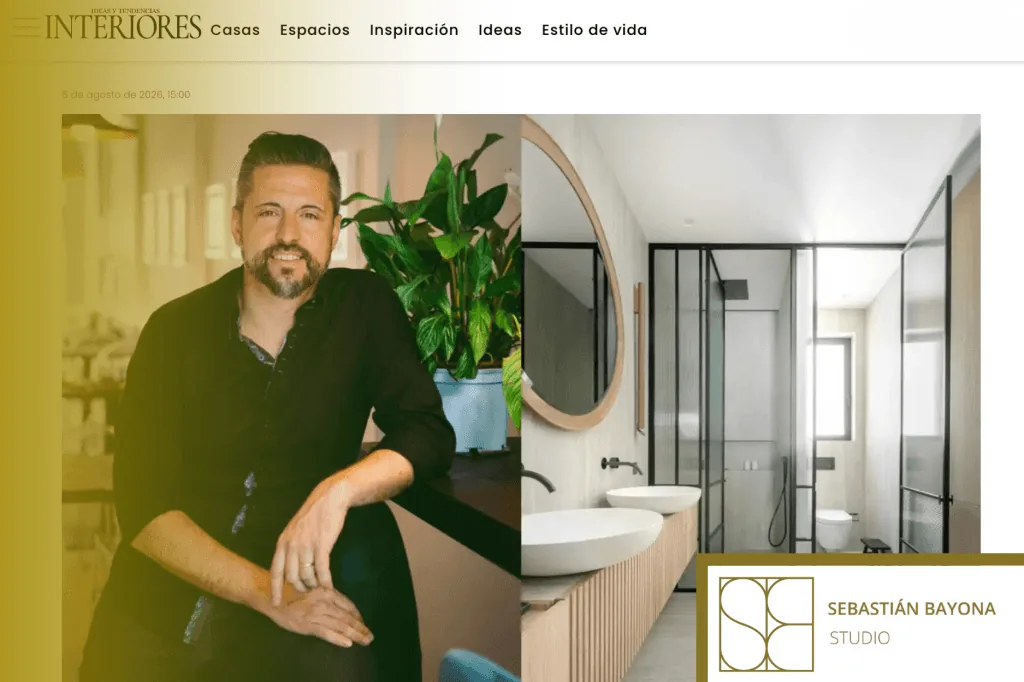
Revista Interiores interviewed Sebastián Bayona to discuss built-in shower trays and why, in certain projects, they can offer greater continuity, durability and design freedom than resin models. The conversation focuses on what truly determines a successful solution: waterproofing, slope, drainage and material selection.
An interview about a decision that changes the entire bathroom
In the feature “Built-in shower trays: an interior designer explains their advantages over resin models”, Revista Interiores presents Sebastián Bayona’s perspective on a choice that may seem minor but can influence the design and performance of the entire shower area.
The conversation begins with a clear preference for shower trays built on site when the renovation allows it. As Sebastián explains: “What I consider the best alternative to resin shower trays are built-in shower trays constructed on site.”
The reason is not simply to replace one product with another, but to integrate the shower into the architecture of the bathroom. When the solution is made to measure, waterproofing, drainage, slopes, finishes and the junction with the shower screen can all be considered together.
Visual continuity begins beneath the flooring
One of the points highlighted in the interview is the possibility of maintaining the same floor finish inside the shower and integrating drainage channels clad in the same material.
This continuity reduces the feeling that the shower is an added element and allows the bathroom to be perceived as a more unified space. However, it should not be understood purely as an aesthetic decision. For it to work properly, waterproofing and water drainage must be resolved from the outset.
For this reason, at Sebastián Bayona Studio, bathroom design and renovation are approached through comprehensive planning, coordinating practical requirements, finishes and installations.
A level-access shower is not always possible
Another important aspect of the interview is the limitation Sebastián identifies when recommending a completely flush shower.
The absence of a step can improve visual continuity and make access easier, but it should not be imposed if the existing conditions do not allow sufficient slope towards the drain. The available depth beneath an old bathtub or shower tray is not always known until demolition begins.
A good interior design decision also means accepting what the actual property allows. If the available levels are insufficient, the shower tray design can be adapted without abandoning the overall concept of integration.
In a full home renovation, these decisions should ideally be coordinated before flooring, installations and junction details are finalised.
Porcelain stoneware and maintenance
Sebastián highlights porcelain stoneware as a particularly suitable material for built-in shower trays because of its durability and low maintenance requirements. In comparison, he mentions microcement, which can provide a highly continuous appearance but requires greater care to prevent staining or cracking.
This comparison is relevant because a shower should not be chosen solely according to how it looks when the renovation is completed. Constant exposure to water, cleaning products and daily use means that durability, maintenance and surface performance must also be considered.
The material forms part of a broader decision. Format, joints, texture, colour and the relationship with the rest of the flooring all influence how the bathroom is perceived, but also how it is used and maintained over time.
The interview was also featured by AS
Sebastián Bayona’s comments reached beyond the specialist interior design press. The newspaper AS also covered the interview, once again highlighting the preference for built-in solutions, flooring continuity, porcelain stoneware and the importance of ensuring the correct slope before designing a level-access shower.
The fact that such a specific reflection on bathroom design reached a general-interest publication is significant. It highlights something that appears constantly in interior design: decisions that initially seem purely aesthetic are closely linked to construction, maintenance and the way a home will actually be used.
Beyond headlines about trends, the principle is simple: there is no single solution that works for every bathroom. The project must begin with the real conditions of each home.
What we take away from this interview
The conversation with Revista Interiores reflects a clear way of understanding interior design: the final appearance matters, but it only works when supported by coherent technical decisions.
A built-in shower tray can provide greater continuity, adapt more effectively to a specific geometry and integrate drainage with greater precision. Its quality, however, depends on aspects that later remain hidden: waterproofing, slopes, levels, junctions and material selection.
Sebastián Bayona Studio develops interior design projects and home renovations in Barcelona, connecting layout, materials, lighting and execution so that every decision responds to the project as a whole.
If you are considering renovating a bathroom or an entire home, you can learn more about our bathroom design and renovation service, see how we approach full renovations or contact the studio to discuss your project.
FREQUENTLY ASKED QUESTIONS
What are the advantages of a built-in shower tray compared with a resin one?
It can be adapted to the dimensions and geometry of the bathroom, maintain continuity with the flooring and integrate drainage more discreetly. The final result depends on correct waterproofing and adequate slope.
Can a shower always be installed flush with the floor?
No. There must be sufficient depth to create the required slope towards the drain. In renovation projects, this level may not be known until the existing bathtub or shower tray has been removed.
Which material does Sebastián Bayona recommend?
In the interview, he highlights porcelain stoneware for its durability and low maintenance. He also mentions microcement, although he notes that it requires greater care to prevent staining or cracking.
Where was the interview published?
The interview was published in Revista Interiores as part of an article about built-in shower trays compared with resin models. Sebastián Bayona’s comments were later also featured by the newspaper AS.