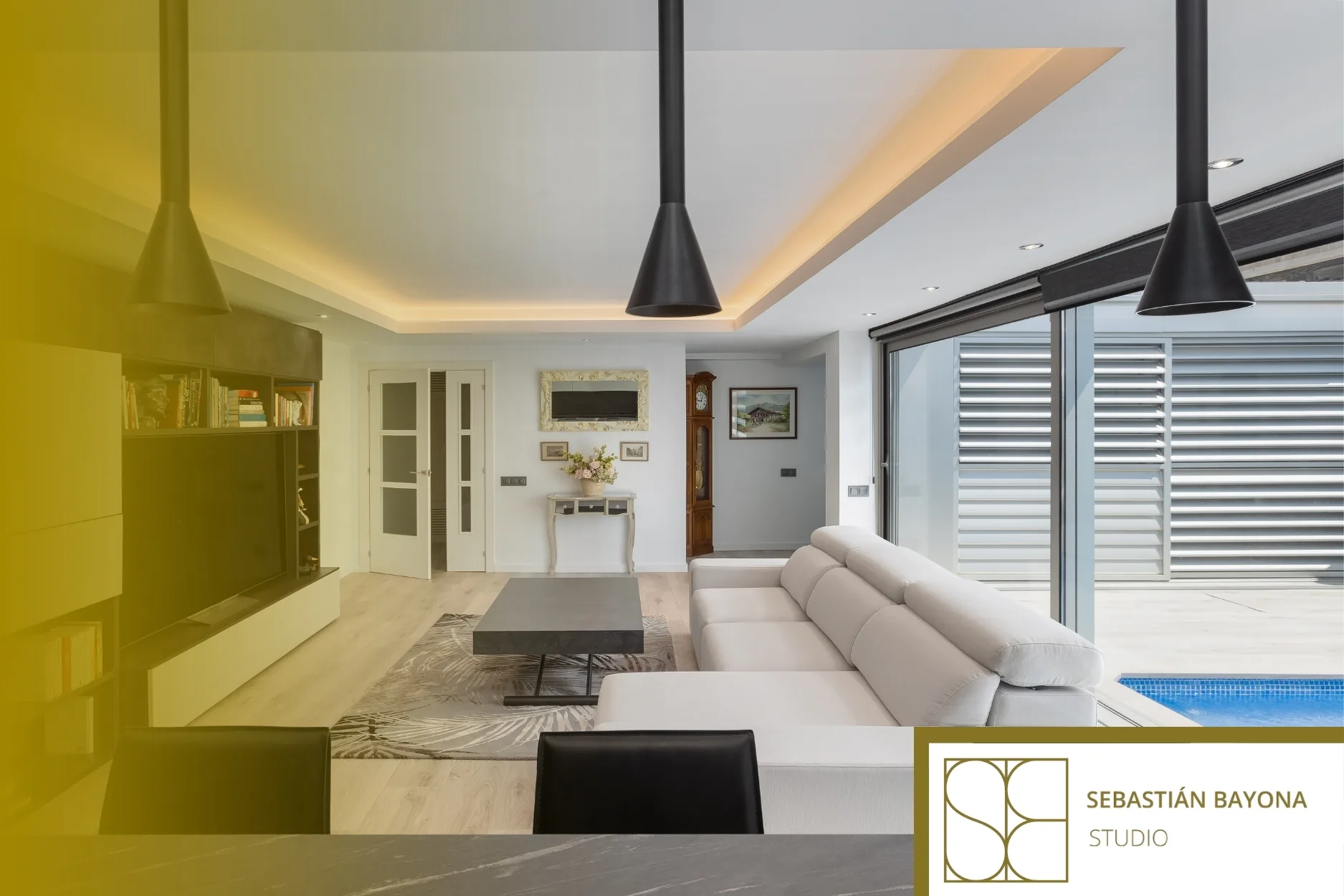
A home can be beautiful and still feel uncomfortable
Some homes appear visually balanced yet become tiring to live in. A conversation requires raising your voice, the television can be heard in the bedrooms, or every sound from the kitchen spreads throughout the living area. These are small disturbances, but when repeated they eventually shape the way the home is used.
Interior design is also experienced through sound. A calm room makes conversation easier and allows different activities to coexist. An excessively reverberant space amplifies voices, footsteps, crockery and appliances, even when none of those sources produces particularly loud noise.
That is why acoustic comfort should not be treated as a final correction. It forms part of the initial decisions about layout, openness, furniture and finishes.
Why some homes sound too loud
Everyday echo often appears in large, sparsely furnished spaces dominated by glass, stone, ceramic surfaces or smooth plaster. Sound bounces between planes and takes longer to fade, making speech less clear and the environment feel noisier.
It is important to distinguish between two issues. Acoustic treatment controls sound within a room; sound insulation limits its transmission between spaces or from outside. The Spanish Technical Building Code addresses them as separate aspects within protection against noise.
A rug can reduce reflections in a living room, but it will not solve noise passing through a party wall on its own. Likewise, a well-fitted door improves separation between areas, although it does not replace a construction-based intervention when there is structural transmission or significant external noise.
How interior design can help
The first tool is layout. Moving a bedroom away from the kitchen, placing a dressing room between spaces, avoiding positioning a workspace on the main circulation route or arranging furniture so that sound sources do not face each other directly can reduce conflicts without adding visual complexity.
The second is absorption: introducing surfaces that balance reflections without turning the home into a technical environment. The third is enclosure. Doors, wardrobe fronts, movable panels and joinery can regulate the relationship between spaces depending on the time of day and activity.
In a full renovation, acoustics, lighting, installations, layout and materials are decided in coordination. Sebastián Bayona Studio develops this residential work from Barcelona and supports the project from the initial analysis through to execution.
Textiles, wood, furniture, panelling and doors
Heavy curtains, upholstery, rugs and certain textile wall finishes help reduce acoustic hardness. Their effect depends on surface area, thickness and placement; a small piece will not compensate for a completely reflective room.
Sofas, armchairs, upholstered headboards and full bookcases break up reflections and prevent sound from behaving as it would in an empty box. Residential furniture can also separate functions and incorporate storage where the floor plan needs it.
Wood requires nuance. A smooth timber panel can reflect sound; a grooved or perforated panel combined with absorbent material can form part of a more effective acoustic treatment. Doors work better when they have sufficient mass, close properly and do not have significant gaps.
Open spaces without giving up calm
An open kitchen improves the relationship between those cooking and those in the living room, but it also spreads voices, extractor noise, running water and the sound of small appliances. The solution is not always to close the space completely again.
A well-designed sliding door, a partial enclosure or an intermediate piece of furniture can regulate the connection. The key is to design degrees of openness: continuity when the activity allows it and protection when several routines overlap.
It is also worth avoiding a situation in which every activity depends on a single central space. Reserving an area for reading, working from home or listening to music without interfering with the rest of the household creates a sense of calm that materials alone cannot achieve.
Circulation, privacy and noise
Sound follows open circulation routes. A hallway aligned with the living room can carry the television towards the bedrooms; one door facing another can make transmission between rooms easier.
Reviewing these relationships forms part of an interior designer’s work during a full renovation. Moving an access point, changing the direction of a door or integrating a wardrobe as a filter can improve privacy, circulation and acoustic comfort at the same time.
When the problem comes from façades, party walls, floor slabs or installations, it needs to be analysed technically. Official guidance on acoustic refurbishment notes that interventions in existing buildings can improve comfort, but the solution must respond to the actual source of the noise.
Comfort appears when we stop noticing it
An acoustically comfortable home does not need to be silent at all times. It should allow everyday sounds to exist without dominating the environment and let each person talk, rest or concentrate with a reasonable level of interference.
That result comes from discreet decisions: where the private area begins, which activity is placed next to another, how a door closes and which surfaces absorb sound. Acoustics then stop being an added layer and become part of the proportion and rhythm of the home.
To explore how layout, materials and furniture can improve the sense of calm in a home, an initial assessment can be requested through the Sebastián Bayona Studio contact page.
FREQUENTLY ASKED QUESTIONS
Why is there an echo in the living room?
It usually appears when hard, parallel surfaces dominate and there are few elements to absorb or diffuse sound. Curtains, upholstery, rugs, furniture and suitable panels can reduce reverberation, although the solution should be adapted to the volume and materials of the room.
Which materials help absorb sound at home?
Thick textiles, upholstered furniture and specific acoustic solutions generally provide absorption. Smooth wood does not always absorb sound: its behaviour changes when it is used in grooved or perforated systems with an absorbent layer behind it.
Can acoustics be improved without major building work?
Yes, when the main problem is internal reverberation. Rearranging furniture, adding curtains or upholstery and improving the closure of certain doors can help. If noise passes through façades, walls or floor slabs, it is advisable to carry out a technical assessment before intervening.
Do open kitchens create more noise?
They can allow voices and appliance sounds to travel more easily into the living room. A well-planned layout, carefully selected appliances and partial or movable enclosures can preserve the visual connection while limiting noise at certain times.