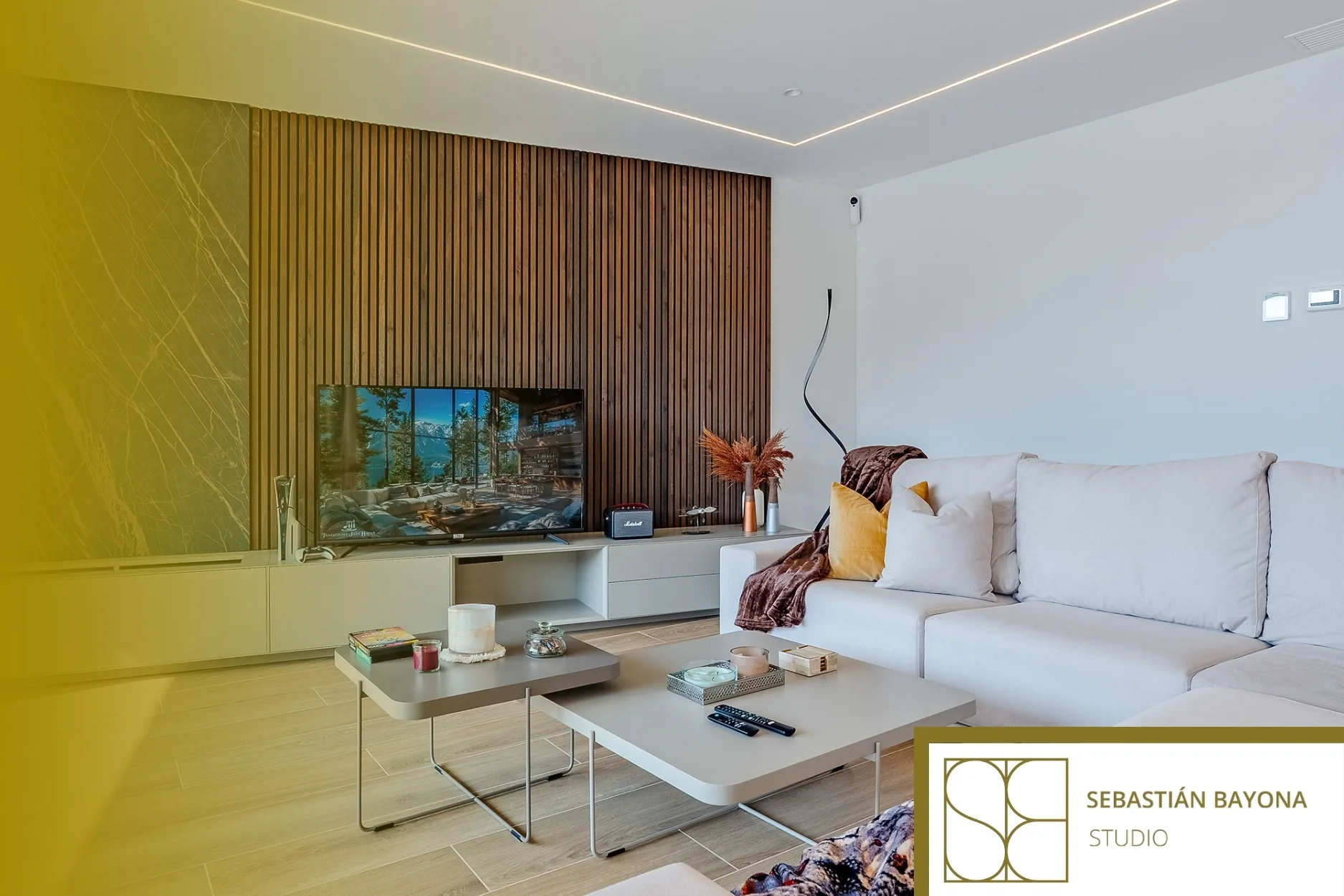
To make better use of natural light in a deep apartment, start by clearing obstructions around windows, examining connections between rooms and choosing finishes that reflect some of the available daylight. Removing every partition is rarely the only option: a repositioned doorway or an internal glazed screen may help brighten adjoining areas while preserving separation and privacy.
Establish where daylight stops reaching
A deep floor plan places some parts of the home a considerable distance from its windows. A bright living room at the façade can therefore sit beside a noticeably darker dining area or hallway further inside.
Before changing the layout, observe the apartment at different times of day. Orientation, neighbouring buildings, balconies above, window dimensions and internal obstructions all affect the result. One photograph taken in favourable conditions does not reveal how the apartment performs throughout the day.
It is also useful to separate limited daylight entering the building from daylight being obstructed inside it. An interior renovation may have little influence over the first problem. The second offers opportunities to reconsider connections and remove specific barriers.
Open a useful connection between rooms
The most effective opening connects a room with available daylight to an adjoining area that needs it. That might mean widening a doorway, moving an entrance or replacing part of an opaque partition with glazing.
For instance, an internal dining area beside a bright living room could benefit from a more generous connection while the kitchen remains separate. This is a design possibility rather than a prescription for every apartment.
Before altering a wall, its construction, services and suitability for modification need to be assessed. The question is where an opening improves daily use as well as daylight. It should sit within a broader understanding of circulation, furniture and the activities taking place on either side.
Internal glazing allows rooms to share light
A glazed partition can allow two spaces to share some available daylight while retaining a physical boundary. It may be useful between a kitchen and dining room or between a perimeter room and an internal workspace.
Clear glass supports visual connection. Translucent glass can restrict views while transmitting light, although its performance depends on the particular product. Frame proportions and the overall glazed area also influence the outcome.
Internal glazing does not introduce a new source of outdoor daylight. It borrows light from another room. Nor does glass alone guarantee sound insulation: the complete assembly, seals and door matter. Decisions about transparency should therefore be coordinated with privacy and the activities the partition needs to separate.
Choose reflective surfaces with restraint
Light-coloured finishes can reflect a greater proportion of the light falling on them. Walls and ceilings deserve particular attention in internal areas because they cover substantial surfaces.
This does not mean removing timber, colour or texture. A lighter background can sit comfortably alongside deeper materials, provided their position does not undermine the limited brightness available at the centre of the plan.
Gloss is not automatically better. Highly reflective finishes can create distracting reflections. Samples should be assessed in the apartment, from the positions where people will sit, work and move through the space. The aim is comfortable brightness rather than a collection of shiny surfaces.
Keep furniture out of the daylight path
A tall cabinet beside a window or a solid shelving unit across an opening can obstruct light. Reviewing furniture positions is a useful first step before considering building work.
Lower pieces may reduce obstructions and preserve sightlines, but storage requirements still need to be met. Bespoke furniture offers a way to coordinate height, depth and position with the apartment’s particular geometry.
Mirrors can reflect a window or an illuminated surface and change the perception of depth. Their usefulness depends on what they reflect. A mirror facing a dark corner is unlikely to achieve the intended effect, and a brighter impression does not establish that a work surface has adequate light.
Place activities where the light supports them
Sometimes the most practical improvement is to move reading or working closer to a window and use internal areas for storage or circulation. This can make better use of the daylight already present without major changes to the apartment.
Borrowed light must also be distinguished from ventilation. An internal space can look brighter without gaining outdoor air or becoming suitable for every proposed use.
Artificial lighting completes the scheme where daylight remains insufficient. It should address particular tasks and routes through the home, rather than leaving the entire internal area dependent on one ceiling fitting.
Assess the whole apartment before removing walls
Sebastián Bayona Studio is a residential interior design studio in Barcelona, considering layout, light, materials and furniture as connected parts of a home. Our residential projects introduce the studio’s work across different homes and requirements.
If the centre of your apartment feels persistently dark, tell us about your project. Understanding the available daylight and the barriers within the plan provides a sound starting point for deciding which connections to improve and which boundaries to retain.
Frequently asked questions
Can an apartment gain daylight without becoming open plan?
Yes. Clearing windows, repositioning furniture, altering a doorway or introducing internal glazing can improve the use of existing daylight. Results depend on the external light available and the relationship between neighbouring rooms.
Can a glazed partition brighten an internal room?
It can allow the room to borrow daylight from an adjoining space. The effect depends on the glazed area, glass specification, distance from the window and obstructions. It is not equivalent to having an external window.
Will white paint solve a dark apartment?
Light-coloured paint can improve the reflection of available daylight, but it cannot compensate fully for limited outdoor light or an obstructive layout. Finishes work best alongside considered furniture placement and connections between rooms.
Do mirrors bring daylight to the back of an apartment?
Mirrors can reflect bright areas and improve the impression of light and depth. Their effect depends on their position and surroundings. They should not be relied on to provide adequate illumination for reading or working.