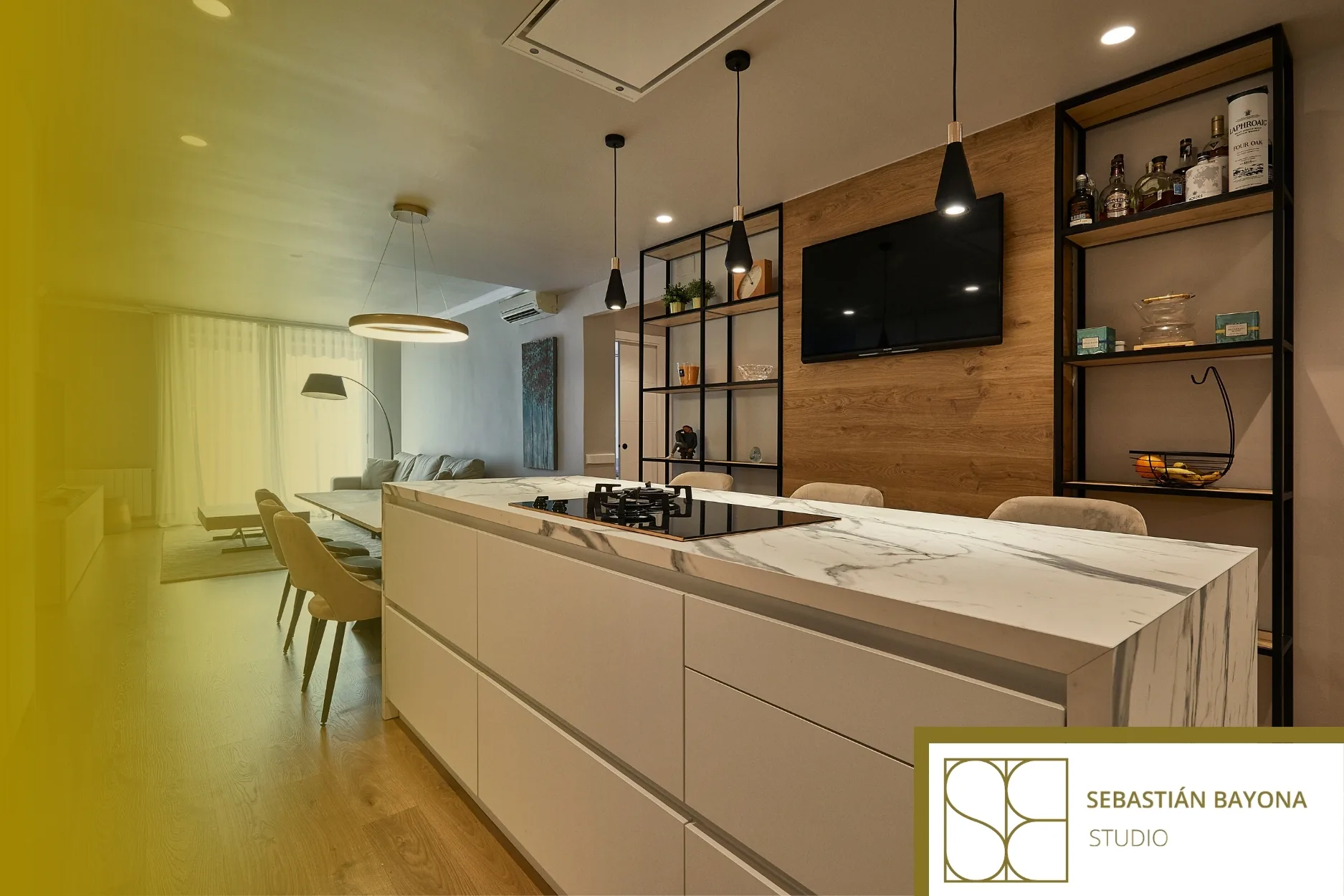
A renovation has a life after construction
A newly completed interior represents a very particular moment. Surfaces are untouched, furniture has just been installed and every detail is seen before everyday life begins to leave its traces.
That moment matters, but it is not the purpose of the project.
Homes are cooked in, cleaned and rearranged. Cabinet doors are opened repeatedly, chairs move across floors and bathroom surfaces encounter water every day. Over time, lamps need attention, fittings may require adjustment and materials begin to age.
Designing with this future in mind is not about avoiding character or choosing only utilitarian finishes. It is about understanding the consequences of each decision.
Sebastián Bayona Studio approaches residential interiors as a connected system of layout, lighting, materials, furniture and execution shaped around the client's way of living. Durability and attention to detail form part of that broader approach.
Choose materials for their future as well as their appearance
The first question about a material should not simply be how it looks when installed.
Flooring experiences foot traffic, abrasion and impact. Kitchen worktops encounter food, water and cleaning products. Walls in circulation areas receive more contact than quieter surfaces. Bathrooms introduce moisture and joints into the equation.
There is therefore no single material that is universally easy to maintain.
Its suitability depends on where it is used, how frequently it is touched, its surface treatment and the expectations of the people living with it.
It is also useful to distinguish ageing from deterioration. Certain materials develop subtle changes that can become part of their character. Others demand more attention if their original appearance is to be preserved.
Sebastián Bayona Studio's official website identifies the selection of appropriate materials for each project as one of its core design considerations, alongside spatial planning, natural light and detailing.
Fewer unnecessary junctions can mean easier care
Maintenance is often hidden in the details.
Every transition between materials creates a junction. Textured surfaces can collect dust. Joints require careful execution, and difficult corners can make routine cleaning unnecessarily awkward.
This does not mean interiors should become visually flat or stripped of detail. The question is whether each additional element has a clear purpose.
Bathrooms and kitchens make this particularly visible. Coordinated joints, controlled changes of plane and well-resolved transitions can support both the visual composition and practical maintenance of the room.
The same principle applies to skirting, joinery, shelving and built-in furniture. Long-term quality often depends less on adding more features and more on resolving how elements meet.
Keep maintainable elements accessible
Some services need to remain visually discreet. Discreet, however, should not mean impossible to reach.
Valves, access panels, mechanisms, equipment and other components may eventually need inspection, adjustment or replacement. Concealing them without considering future access can turn a small maintenance task into a much larger intervention.
Access can be integrated into the design rather than treated as an afterthought. A panel can form part of a joinery composition, for example, while equipment can remain visually controlled without preventing servicing.
A useful principle is straightforward: if something is expected to require inspection or has a limited service life, consider how it will be reached before it is concealed.
Custom furniture should be maintainable too
Built-in furniture can use specific dimensions efficiently, organise storage and create continuity within the architecture. Sebastián Bayona Studio works with both custom furniture solutions and selected catalogue pieces.
For bespoke joinery, repeated use should form part of the design brief.
Handles, hinges, fronts and work surfaces should suit how frequently they will be used. Deep inaccessible compartments or details that make cleaning difficult may look resolved on paper while creating unnecessary inconvenience later.
Durable furniture does not need to be indestructible. It should acknowledge where wear is likely to occur and allow components to continue working properly through adjustment or replacement when required.
Lighting has maintenance needs as well
Good lighting is not simply about brightness. Sebastián Bayona Studio's published approach describes layered lighting that responds to different activities and atmospheres within the home.
Those layers also need to remain practical after installation.
A fitting positioned somewhere extremely difficult to reach may become frustrating when it needs cleaning, adjustment or replacement. Integrated lighting requires particular care in planning access to components.
Complexity should also have a purpose. Lighting controls can improve comfort considerably, but additional technology is most useful when the people living in the home understand and actually benefit from it.
A lighting scheme should be intuitive enough to live with as well as effective enough to shape the atmosphere.
Easy to clean does not have to mean clinical
A home designed around practical care can still be warm, tactile and personal.
The key is to understand where different types of use occur. An entrance receives dirt from outside. Kitchens deal with grease, steam and water. Bathrooms encounter humidity. Upholstery in a frequently used living room has a different maintenance profile from furniture in a guest room.
Material choices can respond accordingly.
Storage and layout matter too. When everyday objects have no logical place, maintaining order requires more effort. A functional floor plan positions storage close to where the need arises rather than simply filling every available wall with cabinetry.
This is where practical maintenance becomes an architectural question rather than simply a cleaning issue.
Allow one part to be repaired without rebuilding everything
Repairability is another dimension of durability.
When developing certain details, it is worth considering what would happen if one component had to be replaced several years later. Could the intervention remain local? Is there access? Would unrelated finishes need to be removed?
Not every future repair can be anticipated, and designing entirely around hypothetical failures would be excessive. But predictable maintenance requirements can often be accommodated with relatively simple decisions made during the project.
This is particularly relevant in an integral home renovation, where services, finishes, lighting, joinery and furniture are developed as interconnected elements.
A home should accommodate change
Maintaining a home does not mean preserving it permanently in its completion-day configuration.
Daily life evolves. A room may later need to accommodate working from home, storage requirements can change and furniture may eventually be replaced.
A layout that depends too heavily on one exact configuration can make these modest changes more difficult.
Adaptability does not mean creating anonymous rooms or avoiding personalised design. It means leaving enough logic within the plan for the home to evolve without every change requiring construction work.
This connects directly with functional planning: circulation, privacy, light and storage work best when they are considered as one system rather than as isolated decisions.
Design for completion day and the years that follow
A renovation should feel resolved when construction finishes, but its quality becomes clearer over time.
Materials need to be considered through the way they age. Details should be judged partly by how they can be cleaned. Services require appropriate access, and furniture needs to accommodate wear.
The objective is not to make a home immune to time. It is to create an interior capable of living with it.
Sebastián Bayona Studio develops residential interior design and integral renovation projects in Barcelona through a global approach to layout, materials, lighting, furniture and execution. If you are planning a renovation, you can contact the studio to consider not only how the finished home will look, but also how it will be used and maintained in the years that follow.
FREQUENTLY ASKED QUESTIONS
Which materials are easiest to maintain after a renovation?
There is no universal answer. Suitability depends on the room, frequency of use, surface finish and level of maintenance you are comfortable with. Resistance, cleaning, repairability and ageing should all be considered.
How can a renovation make future repairs easier?
By providing appropriate access to services and equipment, avoiding irreversible concealment of components that require maintenance and designing details that allow local intervention where reasonably possible.
Does custom furniture require more maintenance?
Not necessarily. Well-designed bespoke furniture can simplify storage and everyday use. Appropriate surfaces and hardware should be selected, while components exposed to regular wear should be capable of adjustment or replacement.
What does it mean for an interior to age well?
It means choosing solutions compatible with real use, understanding the natural behaviour of materials and making cleaning, maintenance and repair manageable. The aim is not to preserve a perfectly untouched appearance but to retain function and visual coherence over time.